Table of contents
Players on live dealer tables are tipping more than ever, and not just the croupier. From Vegas-style “dealer appreciation” chips to digital prompts that pop up mid-hand, a new mechanic is spreading fast: community tipping pools, where contributions are aggregated and redistributed according to preset rules. Operators pitch it as fairer, smoother, and more transparent, yet regulators and player advocates are asking harder questions about pressure, disclosure, and who really benefits when gratuities become a product feature rather than a spontaneous gesture.
From a quiet tip to a system
It used to be simple, and that simplicity mattered. In traditional brick-and-mortar casinos, tipping the dealer has long been customary, culturally variable, and largely voluntary, even if social norms can be powerful. In live dealer studios, the gesture migrated online through a button, a chip icon, or a post-session “thank you” prompt, and then the logic shifted again, because once gratuities are digitised they can be tracked, nudged, bundled, and optimised like any other monetised interaction.
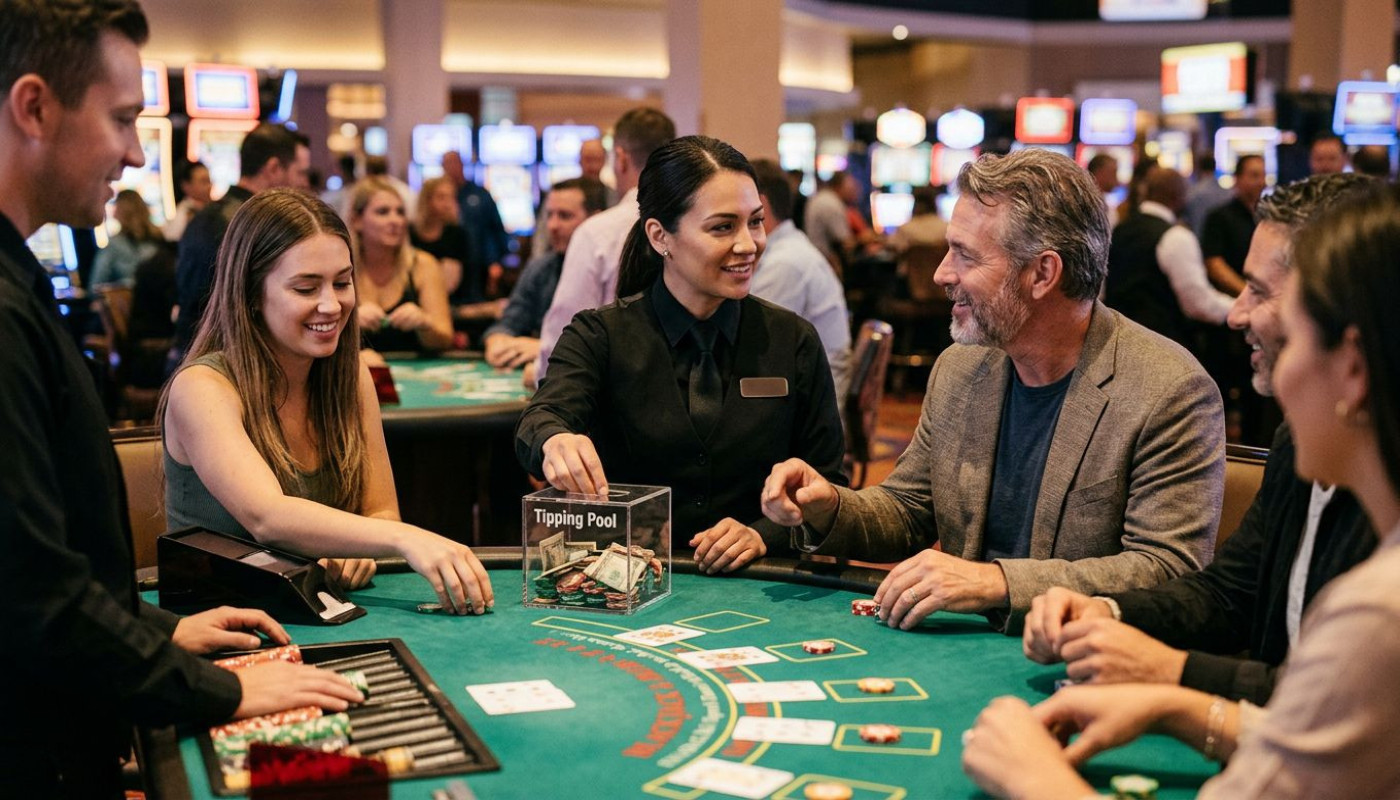
Community tipping pools take that digitisation one step further. Instead of each player tipping “their” dealer in a one-to-one exchange, the table contributes into a shared pot that is later distributed across a team, a shift, or even an entire studio, depending on the operator’s policy. The pitch is familiar: reduce volatility in earnings, smooth out the randomness of big tippers and quiet tables, and prevent situations where a dealer working a lower-traffic game earns materially less than a colleague on a high-volume table. In industries beyond gaming, pooled tipping is not new, and in many jurisdictions it is explicitly regulated; what is new is the way the mechanism can be made invisible, frictionless, and persistent inside a digital interface.
That matters for player behaviour. A pool changes the perceived impact of a tip. Instead of “I’m rewarding the person dealing my hand,” the message becomes “I’m supporting the crew,” or sometimes, more ambiguously, “I’m contributing because everyone else is.” Designers know how sensitive users are to social proof, so features such as running totals, celebratory animations, and public “top contributors” lists can convert tipping from an occasional courtesy into a competitive micro-economy. At that point, the live table is no longer just about cards and conversation, it is also about incentives.
What players notice, and what they don’t
Ask regulars what feels different, and they rarely start with ethics. They talk about rhythm, and pressure. When a tip prompt appears between hands, or when a chat message highlights a pooled contribution, it can interrupt concentration, and in high-speed formats that distraction is not trivial. Live dealer blackjack commonly runs several dozen hands per hour depending on table rules and player count, so even small pauses, repeated, become noticeable. For players managing bankroll carefully, the mental accounting also changes: a £1 tip “now and then” can quietly become £1 every few minutes if the interface keeps asking.
What many players do not notice is how pooled systems can reshape transparency. In a one-to-one model, the player assumes the gratuity is a direct benefit to the dealer in front of them. In a pooled model, the distribution can be broader, and the rules can be complex: equal split across a shift, weighted by hours worked, blended with base pay, or routed through payroll. Without clear disclosure, the player cannot tell whether a tip is a true gratuity, a service charge, or a revenue stream that is merely labelled as a gratuity. Even where operators provide terms, they are often buried behind multiple clicks, and few users read them mid-session.
There is also a second-order effect: the pool can dampen the social connection that makes live dealer products attractive in the first place. Live formats sell “human” play, with banter, rituals, and continuity, and tipping has historically been part of that relationship. When tips become communal and partially anonymous, players may feel less personal satisfaction from giving, and dealers may feel less directly recognised, which can alter the tone of the table. Some studios try to compensate with public acknowledgements, yet that introduces another tension: the more public the acknowledgement, the more it can resemble coercion.
Labour rules, compliance, and awkward questions
Here is the uncomfortable truth: tipping is a labour issue as much as a player feature. In many countries, pooled tips are permitted only under specific conditions, including rules about employer participation, allocation methods, and record-keeping. In the UK, for example, the Employment (Allocation of Tips) Act 2023 is designed to ensure tips go to workers fairly and transparently, with a statutory Code of Practice shaping how employers distribute them. While live dealer studios may operate across borders, and players may be located in different jurisdictions, labour obligations are tied to where the workers are employed, and that can create compliance complexity when a global platform rolls out a one-size-fits-all tipping mechanic.
Regulators, meanwhile, are increasingly focused on “dark patterns” and undue influence in gambling interfaces. A community tipping pool can be benign if it is genuinely optional, clearly explained, and easy to ignore, yet it can also become a subtle form of pressure, especially when paired with visibility features such as leaderboards, chat callouts, or timed prompts. Gambling harm researchers have long noted that small, repeated decisions can erode self-control during play, and while tipping is not a wager, it is still a transfer of money inside a high-arousal environment. That is why some player advocates argue that tipping prompts should be treated more like advertising: clearly labelled, frequency-limited, and never positioned in a way that misleads users about outcomes.
Then comes the question of distribution fairness. Pools are often justified as income smoothing, yet they can also mask disparities. If high-earning tables subsidise low-earning ones, some workers benefit, others may feel penalised. If management influences allocation, trust can erode fast. In physical venues, tip pooling is a well-worn debate between front-of-house and back-of-house staff; in live dealer studios, the equivalent debates can involve dealers, presenters, pit staff, and technical teams. Without independent oversight, the optics are fragile, and for an industry that relies on trust, optics are not a side issue.
When tipping meets the offshore marketplace
The growth of alternative licensing hubs has added another layer, because live dealer content increasingly flows across networks that serve multiple brands, languages, and regulatory regimes. Players who move between strictly regulated sites and offshore platforms often notice that the latter experiment more aggressively with interface mechanics, including social features and monetisation layers. In those environments, tipping pools can be deployed faster, iterated more frequently, and marketed more boldly, because the compliance constraints may be looser, and consumer expectations may be different.
That is also where search behaviour comes in. Many users specifically look for platforms outside national self-exclusion schemes, or they compare features that are uncommon on domestic sites. Queries around non GamStop casinos have grown in visibility in recent years, reflecting a demand that mixes convenience, bonus structures, and access to certain live products. Community tipping pools, with their “club” framing and social signalling, can fit neatly into that offshore proposition, yet they also raise sharper questions about accountability: who audits allocation, how disputes are handled, and what recourse a player has if they believe tipping was misrepresented.
None of this means the mechanism is inherently exploitative. In theory, pooling can reduce income volatility for dealers, and it can protect workers from the randomness of table traffic, which is a real issue in studio environments where game scheduling is tightly managed. But the offshore ecosystem has a track record of pushing frictionless spending, so the line between “supporting staff” and “engineered monetisation” can blur quickly. When tipping becomes gamified, the live table risks turning into a place where social belonging is bought in increments, and where the quiet player feels out of step.
Booking your play, setting a limit
Players should treat tipping pools like any other paid feature: read the policy, set a session budget, and decide in advance whether gratuities are part of it, then stick to that number even if prompts appear. If you are travelling, ask how tips are allocated in that jurisdiction, and whether service charges are included. Where available, use operator tools and local support schemes to limit spending.
Similar articles

Exploring The Thrills Of Free Online Casino Games With Exciting Bonuses

Optimizing online poker play with multi-tabling tips and tools

Strategies To Master Card Counting In Blackjack

Mastering The Bluff: Psychological Tactics In Poker

The Psychology Of Poker: How To Read Your Opponents In Virtual Games
